How Tracey Emin’s Boldness Deepens My Craft‑Led Approach to Art for Workspaces

A visit that opened a deeper connection

I visited the Tate Modern on a very busy second day of Tracey Emin’s Second Life exhibition. This exhibition runs until August. I went expecting to be interested. However, I did not expect to feel such a strong sense of affinity with her work. Her installation My Bed was there, and I was surprised by how long I stood in front of it. I kept taking it in, noticing the layers, the objects, the emotional charge. There was so much to absorb and I found myself captivated by the honesty of it.
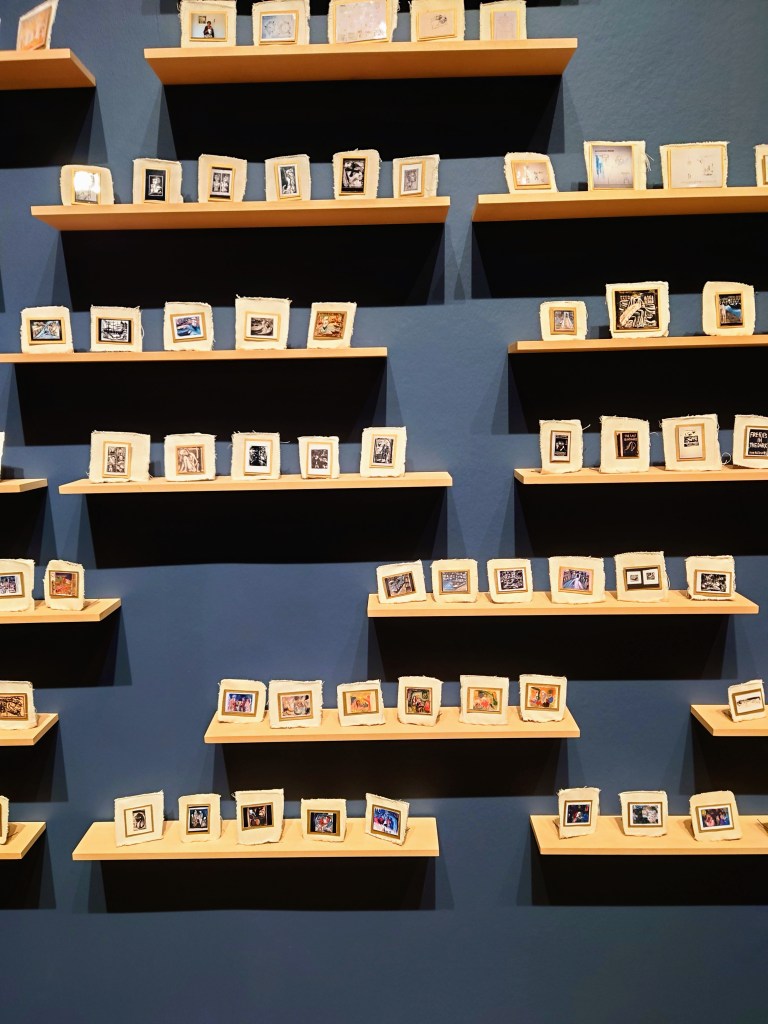
A shelf with blue background featuring  many small miniture artworks of Tracy Emin
Miniature paintings and drawings near the entrance at Tate Modern’s show of Tracey Emin 2026

Craft as a language of emotional honesty

As I moved through the exhibition, I realised how many points of connection I felt with her practice. It was not the autobiographical exposure or the presentation of her physical body. That is not where my own work lives.

Handwritten text and appliqué as emotional markers
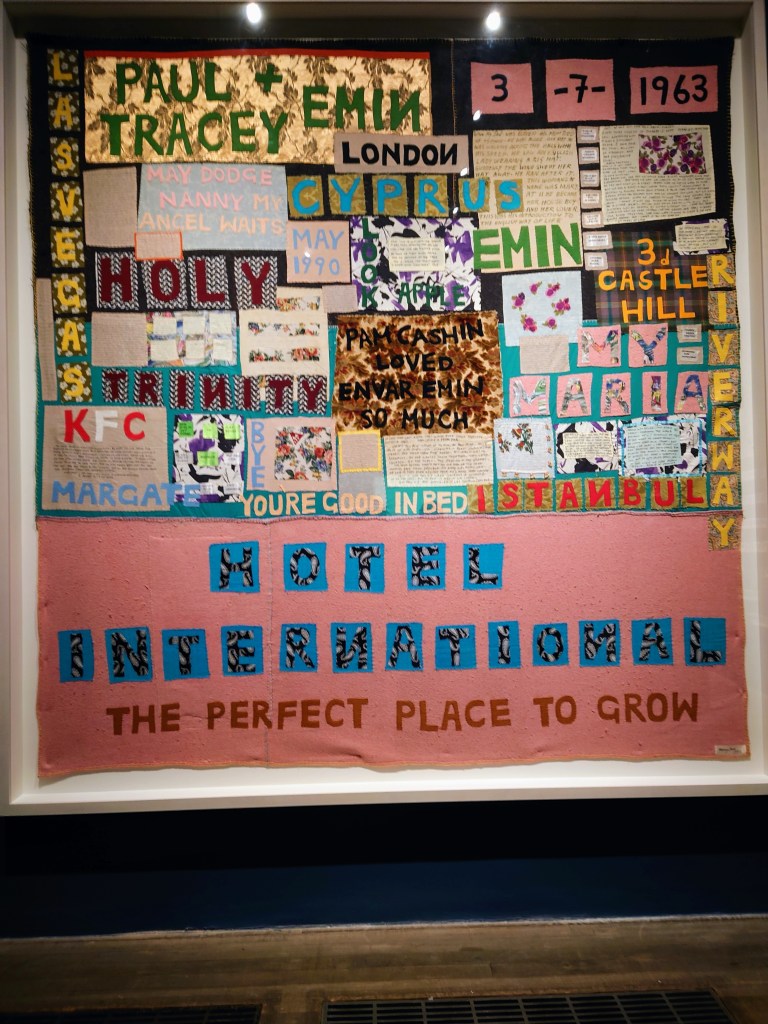
Picture of Tracy Emins artwork which is  blanket with names and dates appliqued. Colours are pink, plue and gold fabric

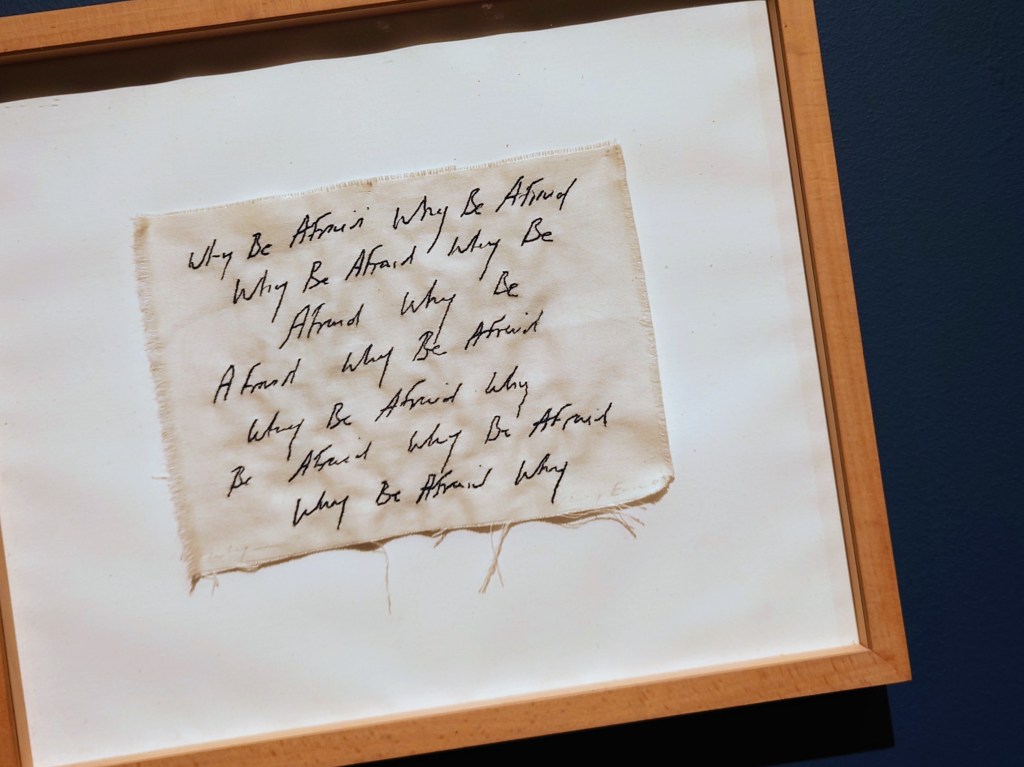
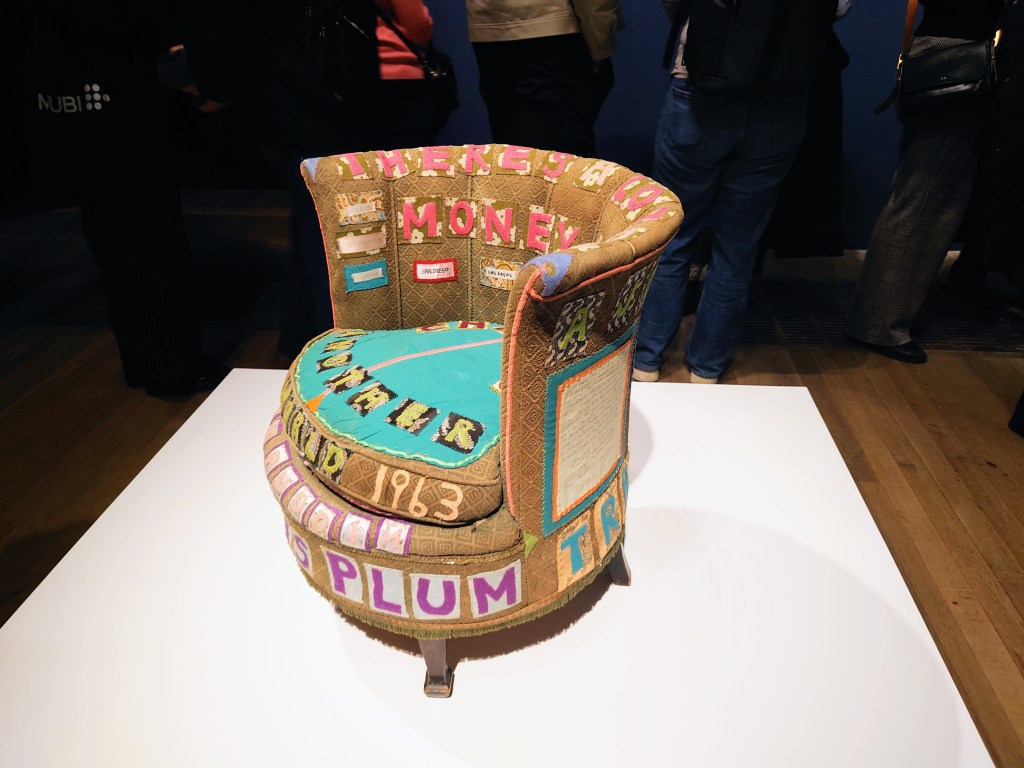
What resonated was her use of craft. The stitching, the embroidery, the appliqué letters, the handwritten text. These are materials and methods I have used quietly for years. I have worked with fabrics, hand sewing, and embroidered photographs. Yet, I have often felt embarrassed about hand stitching. It seemed to belong to a private world that should not be visible in contemporary art. And I was encouraged to see some of the quilters exhibited in USA art galleries like the Smithsonian.

Stitching and embroidery as serious artistic tools

Seeing Emin’s craft presented with such authority changed something for me. Her materials were not softened or made polite. They were not decorative. They were direct, emotional, and unapologetic. Her applique lettering in particular stayed with me. The uneven edges, the rawness of the cut fabric, the sense that the words were lived rather than designed. It gave me permission to explore signage and text in my own work. Her work told me I could do this without smoothing the edges or making everything tidy in my abstract paintings. It reminded me that clarity does not require prettiness.
The expressive power of the drip

I was also struck by the messy drips running down many of her large scale works. They were not accidental. They were not cleaned up. They were part of the emotional structure of the piece. I use drips too. I learned this technique at the Central St Martins course I attended.

Drips as a truthful response to organisational life
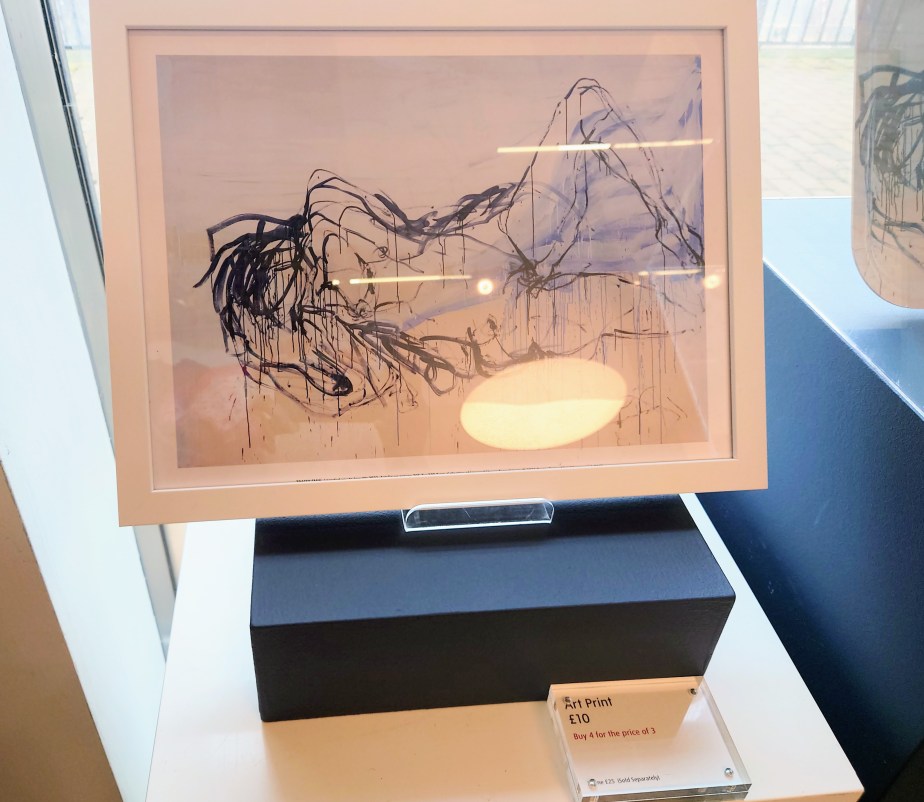
A framed abstract art print featuring flowing black lines and light colours, displayed on a white surface with a black base. A small sign indicates the price.
An expressive art print showcasing abstract lines and drips, reflecting emotional depth and honesty.

I often worried that poured pains and drip work make my work look messy or unfinished. But standing in front of her canvases, I understood something important. The drip is not a flaw. It is a form of honesty. In my own practice, the drip acknowledges the realism of organisational life. The parts that are gory, unpredictable, complex, and resistant to cosmetic treatment. To restrain my mark for the sake of prettiness would mean participating in a surface level gloss. This gloss often hides how work actually feels. Emin’s drips reminded me that boldness is not about being loud. It is about being real with the marks.

Where our practices diverge

There are places where our practices diverge. Emin uses her body as a site of truth telling. I use materiality. She reveals the self directly. I reveal it through construction, colour, texture, and layered surfaces. But the emotional triggers behind the work feel familiar. The lived experiences. The internal negotiations. The moments of rupture and repair.
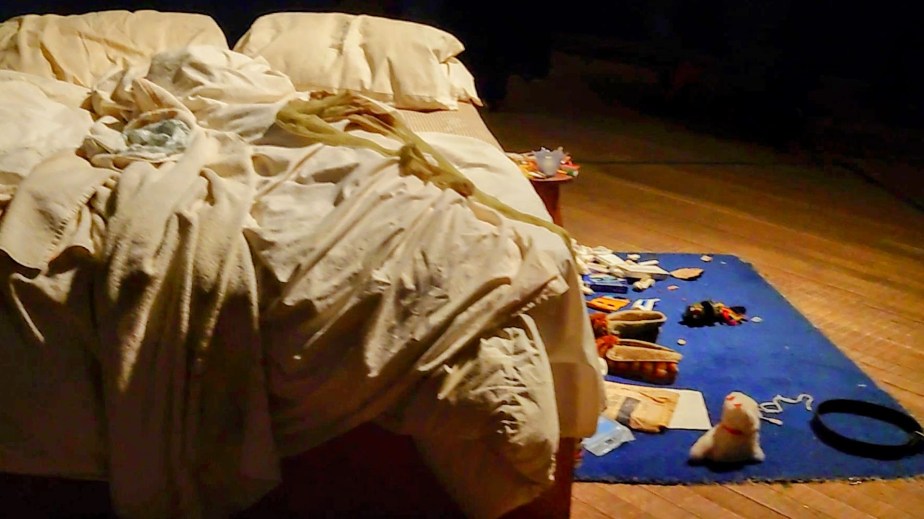
Unmade bed with crumpled sheets and pillows, surrounded by scattered items on a blue rug, including toys and miscellaneous objects.
Tracey Emin’s impactful installation ‘My Bed’, featuring rumpled bedding and scattered personal items, encapsulating emotional honesty.

My work expresses these themes through abstraction and craft. This approach differs from confession. This difference helps collectors understand the kind of presence my work brings into a room. It is not autobiographical exposure. It is emotional resonance.

What this means for art in a home office

As I left the exhibition, I wrote in the visitors book. I wrote about boldness. I wrote about hope. I wrote about the relief of seeing craft treated as a serious artistic language. And I realised that this is exactly what I want my work to bring into someone’s home office. Pride in who they are and how they work. Courage to express their own boldness. Recognition of the complexities of business, economics, and organisational life. Colour and texture that shift the emotional temperature of a room. A sense of companionship from a piece that understands the messiness of ambition.

For some people, this will be a small, bright artwork. It sits on a shelf or desk and lifts the atmosphere of the space. For others, it will be a larger commissioned piece. It transforms a moody or neutral room into something alive. The room becomes grounded and emotionally intelligent. Both are part of the same intention. To bring honesty, colour, and courage into the spaces where we think, work, and make decisions.

Closing reflections on boldness and presence

Emin’s exhibition helps me see my own practice differently. It shows that it sits within a lineage of artists. These artists refuse to tidy the truth. The stitches, the drips, the uneven edges, the layered surfaces. These are not imperfections. They are evidence of a life being lived and understood. They are reminders that work, like art, is rarely neat. There is beauty in acknowledging that messiness. It might sit quietly as a piece of original art on your shelf.

Art that shifts the emotional temperature of a workspace

If you want a piece that brings this kind of presence into your home office, explore the smaller works. They are ready to place on your bookshelf.

If you are imagining something larger and more personal for your space, I would be glad to discuss a commission.

I hope this reflection on Emin’s boldness inspires you to bring a little more of your own boldness into the room where you work.
Autumn reflections on the summer of Transforming Paint Skins into Unique Jewellery, Alcohol Ink art Experiments and asserting my statement

Even with a busy 9-5 schedule, I’ve managed to find some time to experiment. I focus on recovery and taking care of my well-being during downtime. I’ve experimented with creating new items, like transforming my paint skins into brooches, necklace pendants, and cuff links.

I’ve also been painting with alcohol inks and love the wispy ethereal abstract results I get.

I’ve started to understand the ethos of my mark-making. This allows me to start asserting the components of an artist statement for my creations. It’s all about providing an opportunity to focus on the mess.

What do you think about choosing art that portrays the reality of messy situations vs clear, crisp representations of things? It speaks to my critical realism.

Innovative Mixed Media Art: Abstract Monograms and Textured Paintings | Completed

The AI created the above featured image after a few attempts of not getting it quite right. I then asked it to show me an image of a black woman doing finishing touches to artwork and photography. I give it 8/10 this week.

This week I was able to do finishing touches, like mounting an abstract painting on paper onto canvas and setting up for product photography. I also completed the remaining x15 A5 sized artworks on art board.

It has taken over a year to complete the series of about 30 + mixed media artwork featuring paint skins for texture.  I’m also glad to have come up with the concept of paint skin to create abstract versions of the monogram underpainting.

Making an abstract monogram from sculpted paint skins

I love the interesting mix of textures that the offset mosaic like arrangement in the colleage creates.

The knife-sculpted paint skin allows me to extend the boundaries of the canvas, reminding me of overgrown nails. 💅🏽, which I later trimmed down. This has inspired future works.

What things did you finish off this weekK?

Poured Paint Sculpture Lamps: Embracing New Artistic Influences and Future Creations

The featured image above was generated by AI after it analysed all the images on this post. Interesting 🧐 not sure I like it this week.

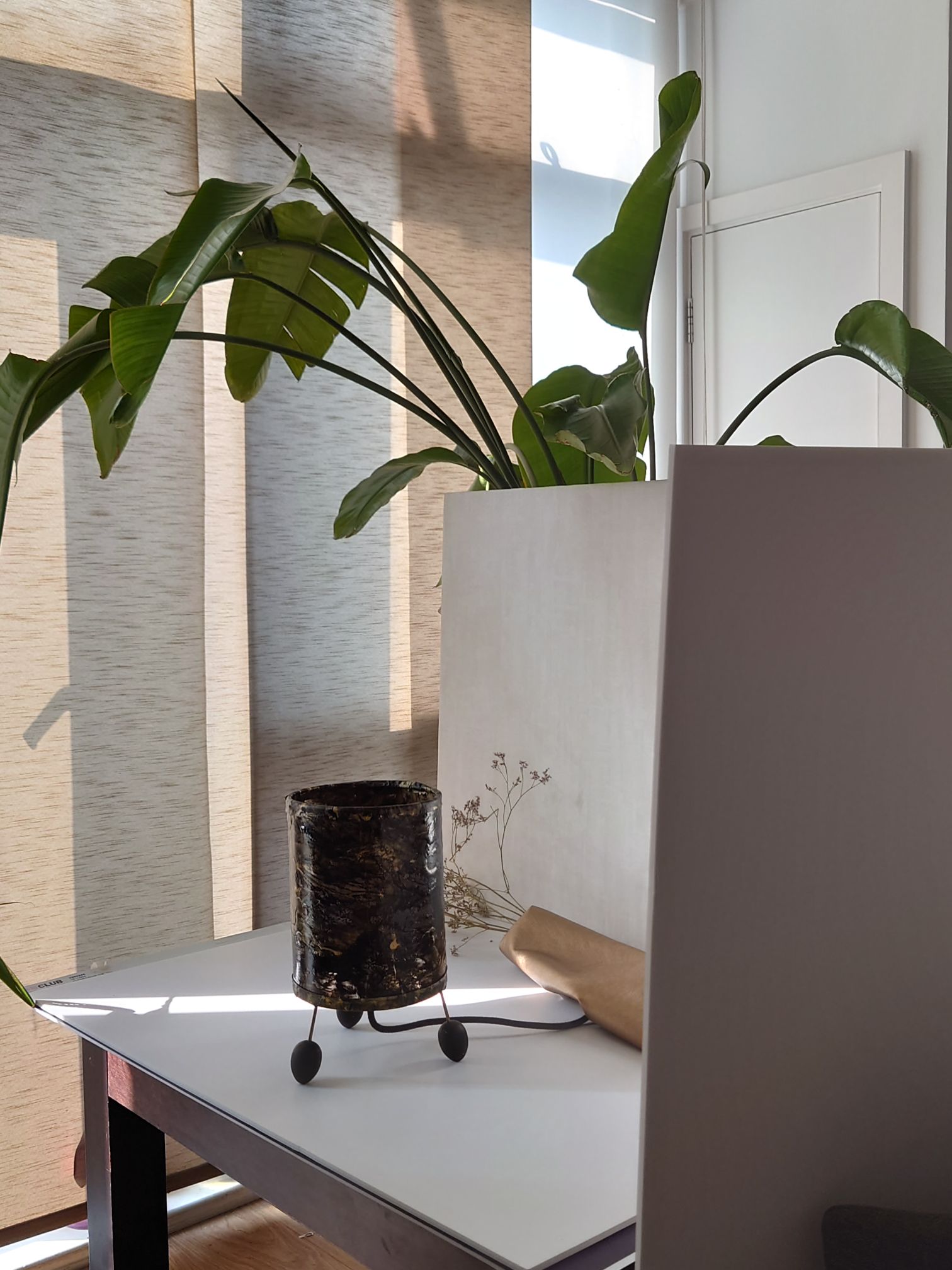
Now that all the lamps have their feet attatched the look is completed. I like that the feet echo the organic black shapes in the poured skin that surflaces the barrel of the lamp.

In creating a series of painted and poured skins and assembling each onto lampshade making backing I first thouhgt I was a bit crazy, but I didnt mind because people had volunteered that they loved what I had created. I later discovered that I am not solitary in making sculpural forms out of paint integrating a clear foundation for a more etherial spirited look. I had learned about sculptural skins before as we were taught that in my mixed media class at Central Saint Martins. But I hadnt come across an artist who had had integrated the clarity of acrylic sheeting in their work.

Poured paint sculpture lamps: The first trio with all their feet fitted, allowing paintings to be formed into semi transparent tablelamps
15 cm acrylic abstract poured on PVC formed to tablelamp signed on the back..
20cm poured acrylic and ink laminated on PVC framed with black cotton formed to tablelamp

Yet, this week I found new company for this sculpural element of my artwork in the work of Lillian Thomas Burrell. This American artist born in 1927 and five years younger than my mother, wrote a book called From Painting to Painting as Sculpture: The Journey of Lilian Thomas Burwell, by Lilian Thomas Burwell, Hampton University Museum.1997. I have orded a signed copy of it.

I learned about her this week, when Kitty Gurnos-Davis of @artistic.identities posted a reel on IG (16th August 2024) talking about the work of Lilian Thomas Burwell (saying she was ashamed to not yet had discovered her). From watching this reel, I entered into a new world. My internet research took me on a journey. I discovered the images of her sculptures made of painting canvas over a wooden form. There are also images and videos of her use of acrylic sheets with wood in her paintings on canvas.

The Lillian Thomas Burrell exhibition at Berry Cambell Gallery from You Tube

My prior career as a management academic allows me to understand the importance of asserting and connecting with the seminal works in my field. I know that using paint skins is something that is a constant in all my work. Seeing and using paint’s sculptural potential is what only a few artists do. It was encouraging to digitally meet the work of Lilian Thomas Burwell this week. I’ve downloaded the book to discover more about this genre and even asked for a signed copy so I can have it to hand for future reference and inspiration..

I shall be making more of these poured paint sculpure lamps in other colours. Purple and gold was requested on instagram and I might do a deep red and organic green and even a yellow and blue later.

What colour would you like to see?

Ethereal Experiments

I was thinking 🧐 of contrasts and reducing my colour palette recently. Below are a couple of images where I played with new forms and hues. This week I was struck by the work of Mexican artist Sandra del Pilar and British artist Sahara Longe. Both seem to assert figures of humanity in subtle ways. I like how their figures seem to give way to the paint and colour form.

My ink drops play for a ghostly theatre round abstract
Continue reading “Ethereal Experiments”